Academic · Research

How do institutions distribute power,
shape participation, and respond to change?

My work ranges from student organizations and democratic governance to algorithmic accountability, presidential power, and international political economy — combining theoretical inquiry with empirical research.

01

What Makes People Show Up: Tasks and the Performance of Voluntary Organizations

Task Theory · Independent Research · 6,000 words

Why do voluntary organizations survive despite the temptation to free-ride? Drawing on 28 hour-long interviews across 30 student-organization cases, I coded qualitative data, developed an original participation index, and ran regression analysis in R. Formal structure showed little consistent effect — participation tracked access to concrete, attributable, bounded hands-on tasks: "Task Theory."

⏳ 论文写作中 · 原文后续上传

Read More · Coming soon
0Hour-long interviews
0Organization cases
6,000Words
RRegression analysis
02

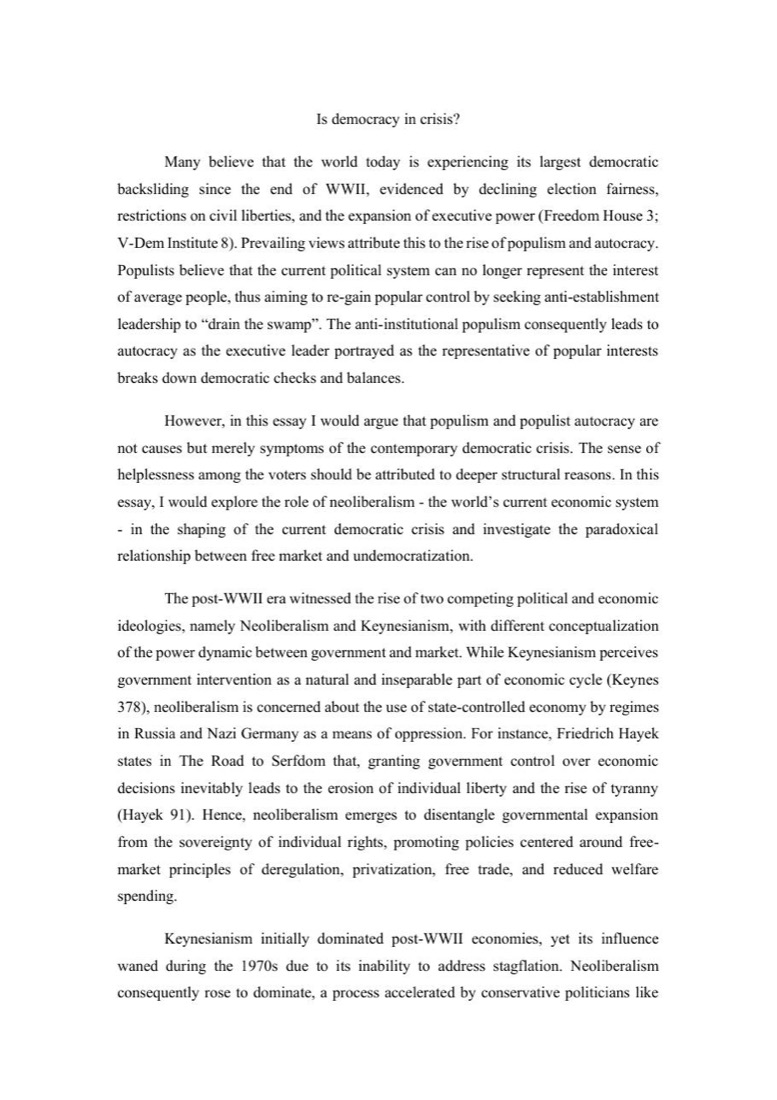
Is Democracy in Crisis?

Neoliberalism Research · 3,000+ words

🏆 Shortlisted · John Locke Institute Global Essay Prize (Politics), 2026

Rather than treating populism as the cause of democratic backsliding, I examine it as a symptom of deeper erosion of popular control under neoliberalism. Drawing on Milnor & Shapley's "Oceanic Games" model, I conceptualize fragmented citizens as "oceanic" players and corporations as powerful "atomic" actors — arguing that deregulation weakens the state's capacity to aggregate citizens into an effective coalition, explaining the post-2008 populist backlash.

Read More
First page of Is Democracy in Crisis 8 pages · PDF
03

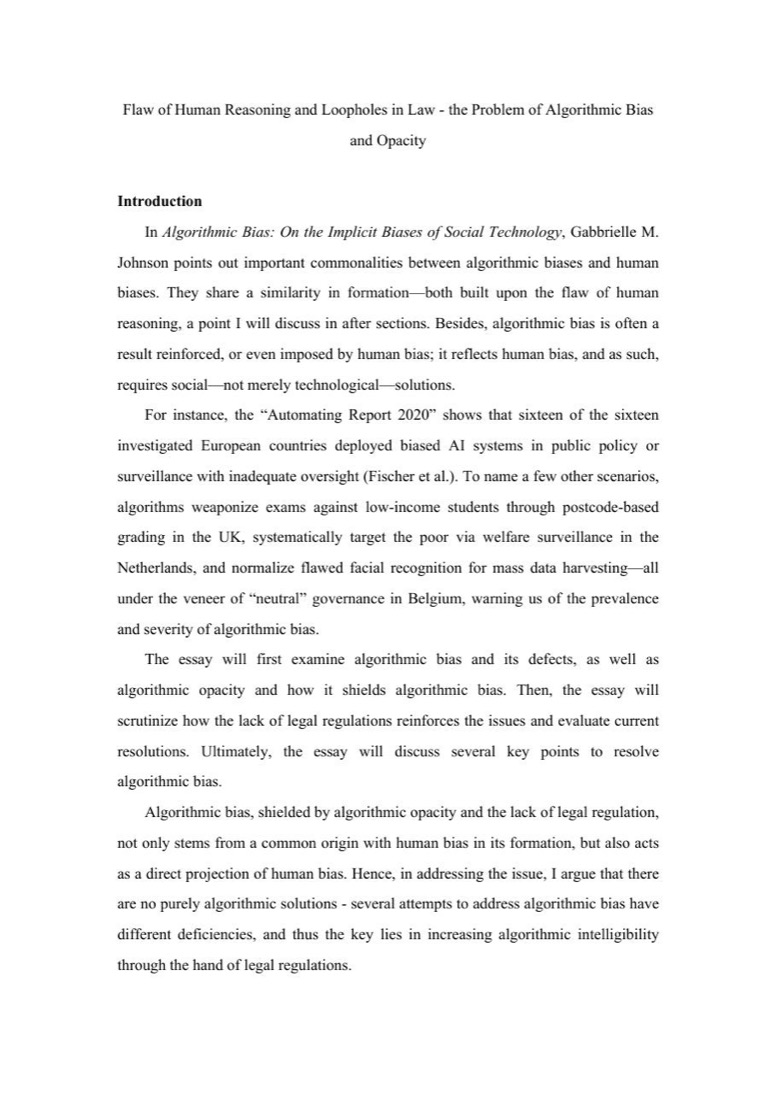
Beyond Transparency: Algorithmic Bias, Opacity, and the Right to Understand

Technology Ethics & AI Governance · 2,000 words · Dr. Xuan An Ho, UT Austin

Algorithmic bias is often treated as a technical problem requiring a technical fix. I argue bias is inseparable from human processes of induction, classification, and judgment encoded into data and models — so technical debiasing alone is insufficient. I propose a legal framework centered not merely on transparency, but on intelligibility: accessible investigation, understandable reasoning, meaningful appeal.

Read More
First page of Beyond Transparency 9 pages · PDF
04

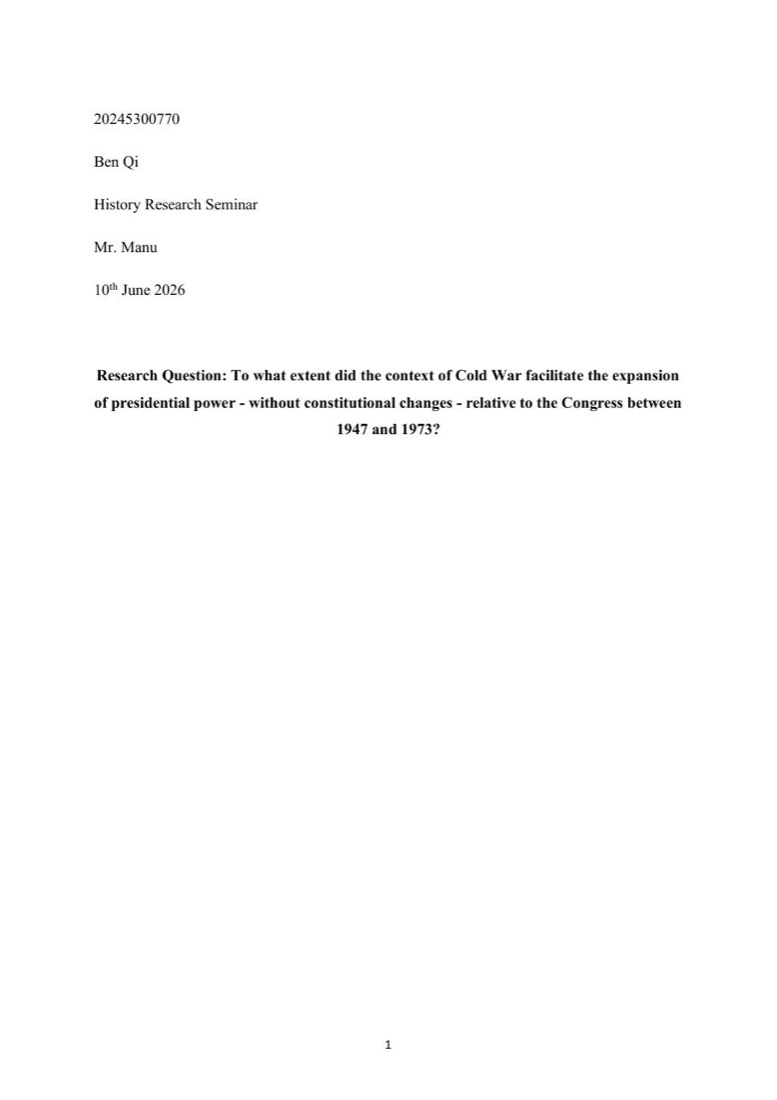
The Constitutional Expansion of American Presidential Power during the Cold War

3,500 words

94/100🥇 Ranked 1st of 17

How can constitutional power expand without the Constitution itself changing? Drawing on 15 primary and 5 secondary sources, I argue the Cold War strengthened presidential authority through the normalization of constitutional reinterpretation rather than formal amendment — repeated crises made speed, secrecy, and executive discretion routine.

Read More
First page of the Presidential Power research paper 13 pages · PDF
05

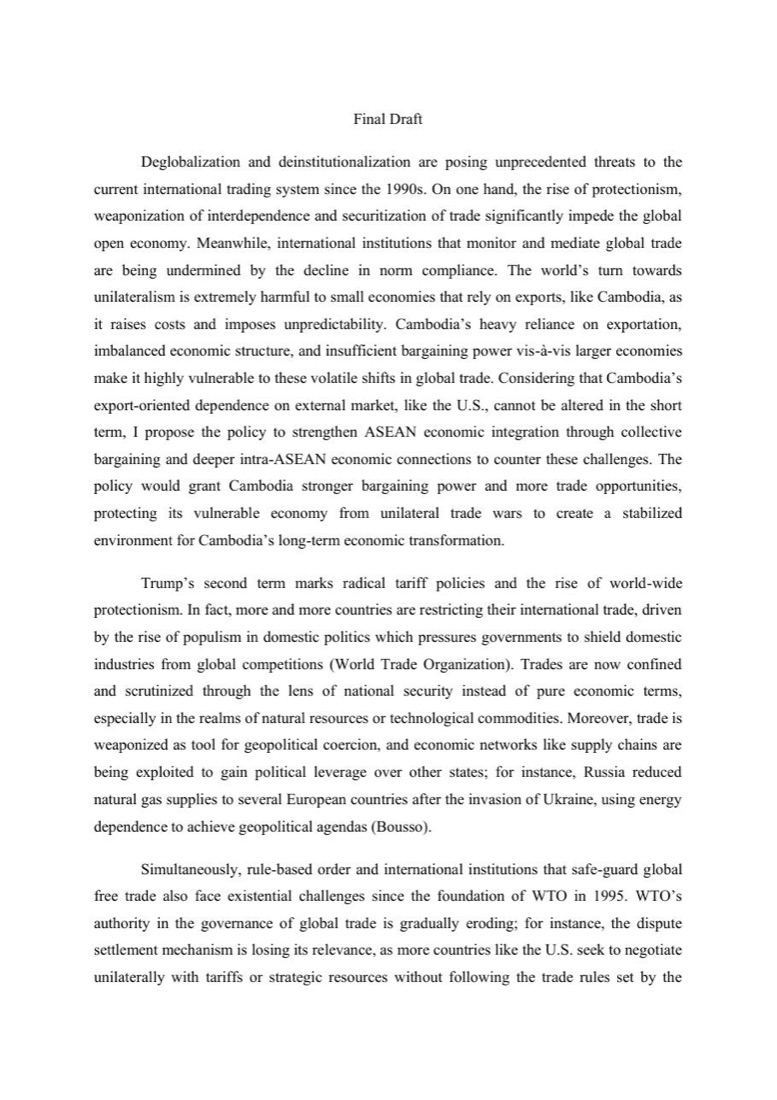
Trade Security in an Era of Deglobalization: The Case of Cambodia

Deglobalization Research · 1,200 words

As globalization fragments, smaller economies face growing exposure to trade disruption and geopolitical pressure. Using Cambodia as a case study, I examine structural trade vulnerabilities and argue for deeper ASEAN integration as a two-stage strategy: strengthening collective bargaining power short-term, while creating conditions for industrial upgrading and economic resilience long-term.

Read More
First page of the Cambodia trade security research paper 6 pages · PDF